NIST vs. Microsoft Zero Trust: Why Cloud Architects Should Care
NIST vs. Microsoft Zero Trust: Why Cloud Architects Should Care
Cybersecurity has changed. The old model of trusting anything inside the network no longer holds up. Zero Trust takes a different approach: trust nothing by default, verify everything.
NIST defines the core ideas behind Zero Trust and gives organizations a strong architectural framework to follow. Microsoft takes those ideas and turns them into a practical, real-world model tied to platforms, tools, and day-to-day operations.
For Cloud Architects, this difference matters. A lot. You need to understand both the theory and the implementation. NIST helps you understand what a solid Zero Trust architecture should look like. Microsoft helps show how that strategy can be applied across cloud services, identities, devices, applications, and data.
This article breaks down the key differences between NIST’s Zero Trust Architecture and Microsoft’s Zero Trust approach. It also explains why that comparison is so important when you are designing secure cloud environments, choosing technologies, and managing risk across hybrid and multi-cloud environments.
The Foundation: NIST's Zero Trust Architecture (ZTA)
NIST Special Publication 800-207, "Zero Trust Architecture," serves as the de facto standard for understanding the theoretical underpinnings of Zero Trust. It defines ZTA not as a product, but as an approach to designing and implementing security principles that safeguard data and services. At its core, NIST's ZTA is built upon three fundamental principles:
- Verify Explicitly: Always authenticate and authorize based on all available data points. This means that every access request, regardless of origin, must be thoroughly validated.
- Use Least Privilege Access: Limit user access with Just-In-Time (JIT), adaptive access controls, and data protection. Access should be granted only for the duration and to the extent necessary.
- Assume Breach: Minimize the blast radius and segment access. Verify end-to-end encryption and leverage analytics for visibility, threat detection, and defense improvement. The assumption of a breach implies that threats may already exist within the network.
NIST emphasizes that ZTA is not a singular architecture but a set of guiding principles for workflow, system design, and operations. It moves defenses from static, network-based perimeters to a focus on users, assets, and resources. A ZTA utilizes these principles to plan enterprise infrastructure, assuming that no implicit trust is granted based on network location or asset ownership. Authentication and authorization are discrete functions performed before a session is established, minimizing uncertainty and focusing on granular, per-request access decisions.
Microsoft's Implementation: A Product-Driven Zero Trust Ecosystem
Microsoft's approach to Zero Trust is deeply embedded within its product ecosystem, offering a practical, actionable framework for organizations to adopt the Zero Trust model. While aligning with NIST's core principles, Microsoft's implementation is more solution-oriented, leveraging its extensive suite of security services across Azure, Microsoft 365, and identity management.
Microsoft's Secure Future Initiative (https://www.microsoft.com/en-us/trust-center/security/secure-future-initiative), launched in November 2023, underscores its commitment to Zero Trust as a cornerstone of its security strategy. SFI emphasizes designing, building, testing, and operating Microsoft technology to the highest security standards, largely through a rigid implementation of Zero Trust principles within its own environment.
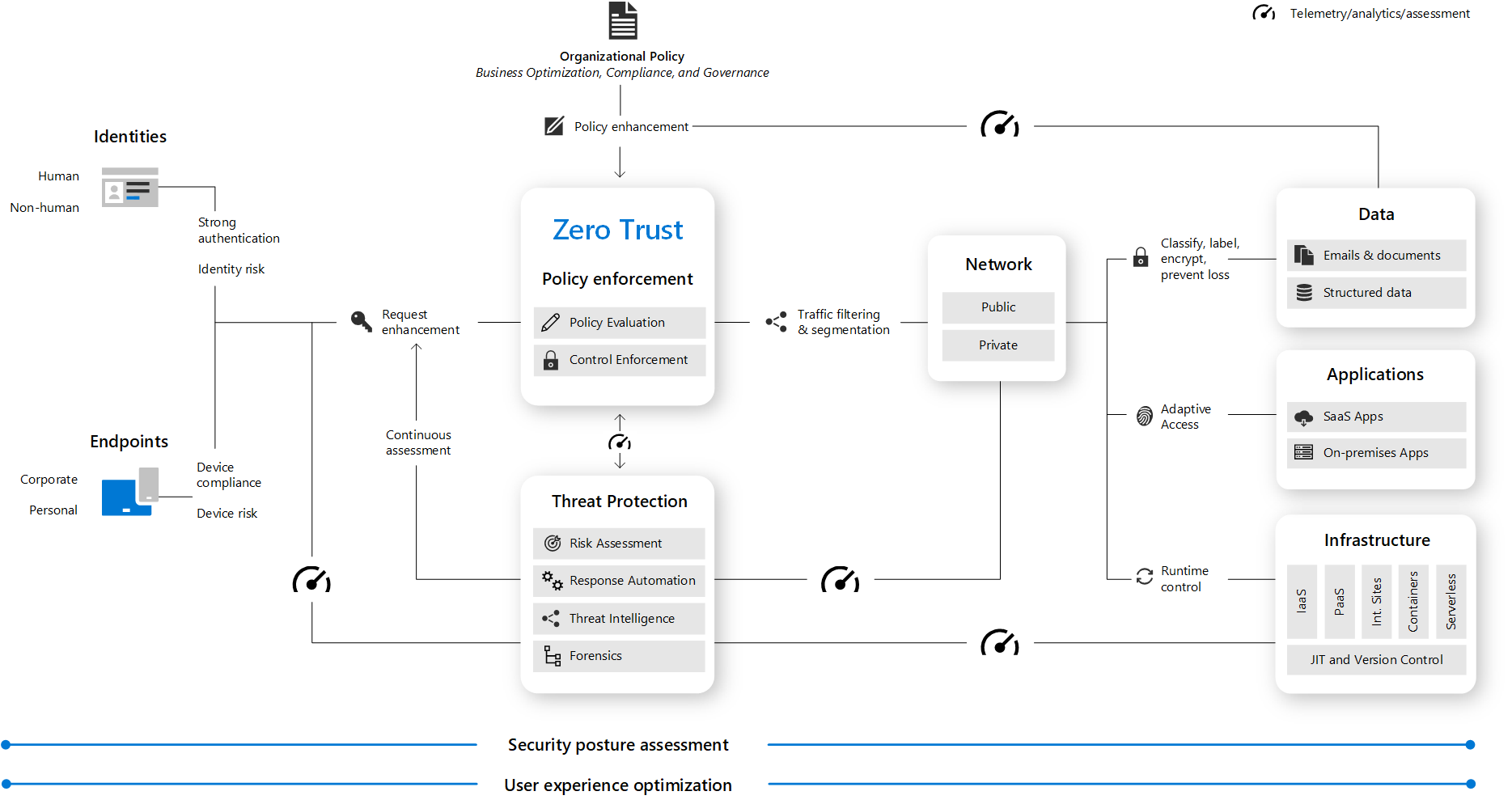
Microsoft's Zero Trust Implementation Components
Microsoft maps its Zero Trust implementation across several key identity and security domains:
- Identities: Microsoft Entra ID (formerly Azure Active Directory) is central to Microsoft's identity-centric Zero Trust strategy. It provides single sign-on (SSO), conditional access policies, identity protection, and robust authentication mechanisms.
- Devices: Microsoft Intune and Microsoft Endpoint Manager are used to manage device identity, posture, and compliance. This ensures that devices accessing resources meet defined security requirements.
- Applications: Microsoft Entra ID also plays a role in securing applications by managing access and enabling single sign-on to both Microsoft and third-party applications.
- Data: Microsoft 365 offers extensive data protection capabilities, including data loss prevention (DLP), sensitivity labels, and information protection, all configurable within a Zero Trust framework.
- Infrastructure: Azure provides a secure foundation for cloud infrastructure, with services like Azure Security Center and Azure Firewall contributing to the Zero Trust posture. Network segmentation and micro-segmentation are achievable through Azure network security groups and virtual network configurations.
- Networks: While Zero Trust de-emphasizes the traditional network perimeter, Microsoft still provides network security controls within Azure and Microsoft 365 to protect data in transit and segment workloads.
- Visibility and Analytics: Microsoft Sentinel, a cloud-native SIEM and SOAR solution, offers comprehensive threat detection, investigation, and automated response capabilities, providing the necessary visibility into security events.
Key Differences: NIST's Framework vs. Microsoft's Implementation
While aligned in principles, the divergence between NIST and Microsoft's Zero Trust lies in their nature and presentation:
-
Conceptual vs. Practical: NIST provides a high-level, vendor-agnostic blueprint for Zero Trust. It defines the 'what' and 'why' of ZTA, offering a conceptual model that any organization can adapt. Microsoft, on the other hand, provides the 'how' through its integrated product suite. Its guidance is often tied to enabling specific Microsoft technologies to achieve Zero Trust outcomes.
-
Scope and Focus: NIST's ZTA is broadly applicable to any enterprise, focusing on the logical components and architectural principles. Microsoft's implementation is naturally focused on securing its own cloud and software services, though its principles are extensible. Cloud Architects working within a Microsoft-centric environment will find direct pathways to implementation.
-
Actionability: NIST's framework requires significant interpretation and translation into specific technologies and policies. Microsoft's approach offers more immediate actionability for organizations already invested in its ecosystem, providing specific tools and configurations to achieve Zero Trust objectives.
-
Vendor Neutrality vs. Vendor Alignment: NIST's guidance is vendor-neutral, promoting open standards and architectural flexibility. Microsoft's implementation, while adhering to Zero Trust principles, naturally leads to the adoption of Microsoft's security products and services. This can simplify integration but may introduce vendor lock-in if not managed carefully.
-
Emphasis on Legacy Systems: NIST acknowledges the existence of hybrid environments and the need to integrate ZTA with existing perimeter-based architectures. Microsoft's solutions are generally geared towards modern, cloud-native or hybrid cloud deployments, with a strong emphasis on leveraging its cloud services.
In 2011, Google launched an internal initiative called BeyondCorp, which pioneered the "Zero Trust" security model. This approach was designed to let employees work securely from any location without the need for a traditional VPN. Instead of assuming that everyone inside an office network is safe, BeyondCorp shifts security checks to the individual user and their specific device. By verifying who is logging in and the health of their computer every single time, Google made it possible for staff to work from untrusted networks (like home or public Wi-Fi) with greater safety and flexibility than ever before.
Why This Distinction Matters to Cloud Architects
For Cloud Architects, the differences between NIST's framework and Microsoft's implementation have profound implications:
-
Strategic Planning: Understanding NIST's ZTA provides a robust theoretical foundation for designing a secure enterprise. It helps architects think critically about the core principles and how they should be applied, regardless of the vendor. This allows for more strategic planning that is not solely dictated by product capabilities.
-
Technology Selection: When architecting cloud solutions, especially in hybrid or multi-cloud environments, Cloud Architects must choose technologies that align with Zero Trust principles. Knowing NIST's fundamental requirements helps in evaluating vendor solutions, including Microsoft's, based on their adherence to these principles rather than just their feature sets. Microsoft's offerings provide a clear path for those committed to its ecosystem, but an architect might need to bridge gaps with other vendors if a multi-cloud strategy is in place.
-
Risk Management: NIST's guidance on assuming breach and granular access control directly informs risk assessments. Cloud Architects must translate these principles into concrete security controls. Microsoft's tools provide the means to implement these controls (e.g., conditional access policies based on device health), but the architect must understand the underlying risk that these controls are mitigating.
-
Integration Challenges: In a heterogeneous cloud environment, integrating different security solutions can be complex. NIST's emphasis on logical components and policy engines can help architects design for interoperability. Conversely, relying solely on Microsoft's ecosystem might simplify integration within that ecosystem but could create challenges when connecting with non-Microsoft cloud services or on-premises resources.
-
Cost and Complexity: Microsoft's integrated approach can sometimes lead to simplified deployment and management, potentially reducing complexity and cost if the organization is already heavily invested in Microsoft products. However, a purely Microsoft-centric Zero Trust strategy might not be cost-effective or technically feasible for all organizations, especially those with diverse cloud footprints.
-
Future-Proofing: By understanding the foundational principles outlined by NIST, Cloud Architects can design systems that are more adaptable to future technological advancements and evolving threat landscapes. This foundational understanding is crucial for ensuring that security strategies remain relevant and effective over time.
TL;DR :)
The Zero Trust model is no longer a niche concept; it's a strategic imperative for modern cybersecurity. NIST provides the authoritative, vendor-neutral blueprint for what Zero Trust architecture should entail. Microsoft offers a tangible, product-driven path for organizations to achieve it, particularly within its cloud and software ecosystems. For Cloud Architects, the ability to navigate the space between NIST's guiding principles and Microsoft's practical implementations is crucial. By understanding the strengths and differences of each, architects can design and build secure, resilient, and adaptable cloud environments that effectively defend against the ever-evolving threat landscape.
This dual understanding empowers Cloud Architects to make informed decisions, select the right tools, and implement a Zero Trust strategy that is not only effective today but also future-proof for tomorrow's challenges.
Newsletter
Stay ahead of the cloud curve.
Practical hybrid & multi-cloud insights, straight to your inbox. No spam — unsubscribe anytime.